
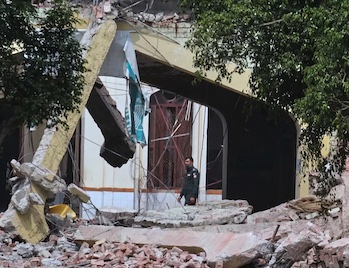
The Indian army has launched “Operation Sindoor” – hitting nine sites in Pakistan and Pakistan-administered Jammu and Kashmir.
A statement issued by India’s Defence Ministry at 1:44am on Wednesday said the armed forces carried out precision strikes on terrorist infrastructure in Pakistan and PoK “from where terrorist attacks against India have been planned and directed”.
“Our actions have been focused, measured and non-escalatory in nature. No Pakistan military facilities have been targeted,” the statement said, adding that “India has demonstrated considerable restraint in selection of targets and method of execution.”
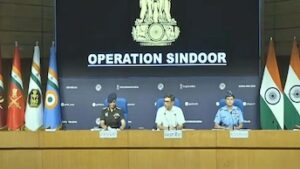
Foreign Secretary Vikram Misri, Colonel Sofiya Qureshi, and Wing Commander Vyomika Singh on Wednesday, 7 April, briefed the media on Operation Sindoor at the National Media Centre in New Delhi.
The briefing gave a strong and significant message, as two women officers – Wing Commander Vyomika Singh and Colonel Sofiya Qureshi – took the lead.
The officials said that the operation was a targeted attack on Pakistani terrorist infrastructure and did not target any military establishments. They noted that five sites in Pakistan-occupied Jammu and Kashmir (PoK) and four sites in Pakistan were targeted by the Indian defence forces.
“Earlier this morning, as you may be aware, India exercised its right to respond. These actions were measured, non-escalatory, proportionate, and responsible. The focus was on dismantling terrorist infrastructure and disabling elements likely to carry out attacks across India,” Colonel Qureshi explained alongside Wing Commander Singh.
The name ‘Operation Sindoor’ — is a reference to the red vermillion that Indian women wear to signify their married status. In the Pahalgam terror attack last month, the husbands of several Indian women were killed in front of them, including an Indian Navy officer.
Over 200 flights were cancelled and at least 18 airports — including Srinagar, Leh, Amritsar and Chandigarh — were shut temporarily on Wednesday.
Flight operations were suspended across key northern and western airports, including Jammu, Pathankot, Jodhpur, Jaisalmer, Shimla, Dharamshala and Jamnagar, amid heightened security restrictions. Air India, IndiGo, SpiceJet, Air India Express, Akasa Air and several foreign carriers called off services to and from affected regions.
Pakistan’s military meanwhile said India had attacked Pakistan with missiles in three places and that Islamabad would respond. Pakistan has cleared its airspace for 48 hours.
Pakistan’s DG ISPR, Lt Gen Ahmed Sharif Chaudhary said that India struck sites in Kotli, Muridke, Bahawalpur and Muzaffarabad.
Muridke is the headquarters of the terrorist group Lashkar-e-Taiba, which is run by Hafiz Saeed, and Bahalwapur in Pakistan’s Punjab province is the base of Jaish-e-Mohammad, an outfit run by Masood Azhar.
Two civilians in Kotli, in Pakistan-administered Kashmir and a child in Bahwalpur, Pakistan, have been killed in India’s strikes, Lt Gen Chaudhary said. He also said that a family including a child, have been trapped under the rubble of a collapsed house.
Twelve more civilians were injured in Ahmedpur Sharqia in Bahwalpur, according to reports from Pakistani media Geo News.
The Operation Sindoor strikes are the most extensive missile attacks by India on Pakistan and the territory it controls outside the wars the nuclear-armed neighbours have fought.
Pakistani Prime Minister Shehbaz Sharif confirmed that India conducted precision military strikes and said, “Pakistan has every right to respond forcefully to this act of war imposed by India, and a forceful response is being given.”
When asked about the Indian strikes, US President Donald Trump told the BBC: “It’s a shame”.
Trump said at the White House: “We just heard about it just as we were walking in the doors of the Oval [Office].”
“I just hope it ends very quickly,” he said.
Tensions have soared between the nuclear-armed neighbours over last month’s militant attack on tourists in the Indian-controlled portion of Kashmir. India has blamed Pakistan for backing the militant attack, which Islamabad has denied.
In 2019, Indian fighter jets bombed Balakot in Pakistan’s Khyber Pakhtunkhwa province after a suicide bomber killed 40 Indian paramilitary soldiers in Indian-administered Kashmir.
The United Nations has called for maximum restraint from both India and Pakistan. “The secretary-general [António Guterres] is very concerned about the Indian military operations across the Line of Control and international border. He calls for maximum military restraint from both countries,” the spokesperson said. “The world cannot afford a military confrontation between India and Pakistan.”
(Agencies; Picture Courtesy: Reuters, AP)