Muslim scholars visiting the Vatican Apostolic Library are being accommodated with prayer spaces, its Vice Prefect has confirmed.
The disclosure came not through a press release, but in a casual remark during an interview with La Repubblica on October 8.
Fr Giacomo Cardinali, Vice Prefect, said in an interview with the Italian newspaper La Repubblica that Muslim academics had requested a small area in which to pray, and the library had agreed. “Some Muslim scholars have asked us for a room with a carpet for praying and we have given it to them,” he said.
The Vatican Library, often regarded as the intellectual heart of the Catholic Church, houses a vast array of manuscripts and texts from across the world’s religions and cultures. One of the oldest in the world, the library has been collecting religious texts from across the world since it was formally established in 1475 by Pope Sixtus IV. Fr Cardinali said its collections include “incredibly old Qurans” alongside Hebrew, Ethiopian, Arabic, and Chinese works. “We are a universal library,” he explained.
The Vice Prefect also drew attention to some of the more unusual items in the collection, such as what is believed to be the oldest medieval Japanese archive outside Japan. The archive was preserved thanks to a Salesian missionary, Father Mario Marega, who lived in Japan during the 1920s. Today, the library contains around 80,000 manuscripts, 50,000 archival items, 100,000 engravings, prints, coins & medals and nearly two million printed books. New discoveries continue to emerge, including a rare manuscript of Spinoza’s Ethics unearthed in recent years.
What began as a gesture of hospitality toward visiting scholars has become a lightning rod for controversy. The revelation that Muslim researchers have been granted a dedicated room with a prayer rug inside the Vatican Apostolic Library has stirred debate over the limits of openness in one of the Church’s most symbolic institutions.
The Vatican’s accommodations stand in stark contrast to other faiths, which forbid or severely restrict Christians from visiting certain holy sites. Non-Muslims are not allowed to visit Islam’s holy city of Mecca, for example.
Some have criticised the Church’s decision as “effectively allowing a rival faith to set up shop on its property.” “A library is for reading, not for worship,” one Catholic commentator wrote, echoing a concern quietly shared by many in the Vatican’s own academic circles. Cardinali described the library in the same interview as “the most secular of all Vatican institutions,” calling it “a humanistic institution.” The remark has left some observers wondering how such self-definition fits with the decision to provide a space explicitly designated for religious practice — and for a religion other than Catholicism.
Others described the move as a way for the Church to display that “truth has nothing to fear from study.”
Pope Leo XIV has in his ministry so far placed an emphasis on interfaith dialogue. In May, Pope Leo hosted inter-religious delegations at the Holy See to boost ecumenism, saying that Christians should unite “in a spirit of human fraternity.”
Pope Leo’s language mirrors that of his predecessor, Pope Francis, who “promoted both the ecumenical path and inter-religious dialogue,” the current Pope said.
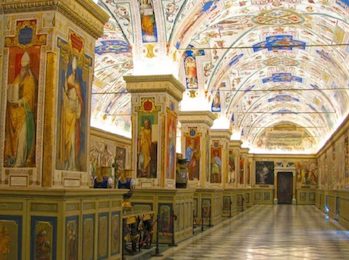
(Agencies; Picture Courtesy: Zenit; Picture of Vatican Apostolic Library used for illustrative purpose only)