In the early hours of February 28, 2026, the United States and Israel launched a massive, coordinated preemptive military strike against Iran.
The daylight assault targeted multiple cities across the country, including the capital Tehran, Qom, Isfahan, Kermanshah, and Karaj. Israel has officially designated its campaign “Operation Lion’s Roar,” while the Pentagon is referring to the American military action as “Operation Epic Fury.”
The attacks that targeted Iranian leadership has plunged the Middle East into a new conflict that President Donald Trump said would end a security threat to the US and give Iranians a chance to topple their rulers.
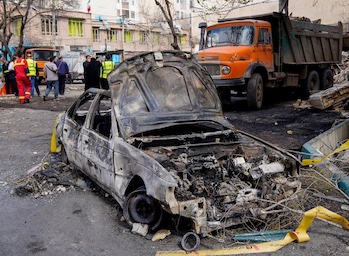
Tehran responded by launching missiles at Israel. Explosions also rang out in nearby oil-producing Gulf Arab countries, which said they had intercepted missiles from Iran after Tehran warned it would strike the region if it was attacked.
Iran’s state-run IRNA news agency reports at least 57 people killed at a girls’ school in southern Iran.
A missile strike in Dubai reportedly killed one person, and shrapnel has been reported in Abu Dhabi and Riyadh. Videos from Dubai — including shots near Burj Al Arab and Kite Beach in Umm Suqeim — showed bright flashes in the sky as the UAE’s air defence systems intercepted Iranian missiles launched towards the UAE.
The UAE has condemned and denounced in the strongest terms the blatant Iranian missile attacks that targeted the country and several brotherly nations in the region, considering these acts a flagrant violation of national sovereignty and a clear breach of international law and the Charter of the United Nations.
Dubai International Airport and Al Maktoum Airport have suspended all flight operations amid escalating regional hostilities following Iranian missile strikes across Gulf states. Authorities urged passengers not to travel as thousands were stranded after flights were abruptly grounded.
Iran’s foreign minister told counterparts from Saudi Arabia, the UAE, Qatar, Kuwait, Bahrain and Iraq that Tehran would use all its defensive and military capabilities to defend itself.
Iran’s Fars News Agency confirmed that Iran had carried out attacks targeting military bases in each of the states, including Al Udeid Air Base in Qatar and the headquarters of the US Navy’s 5th Fleet in Bahrain.
Qatar’s Defence Ministry said it had “successfully thwarted a number of attacks targeting the country’s territory”, after several rounds of alerts sounded.
Loud booms sounded in the UAE capital Abu Dhabi, an oil producer and US ally. Fighter jets flew around the Yas Island area of Abu Dhabi on Saturday afternoon.
Explosions were also heard in Saudi Arabia’s capital, Riyadh.
Jordan also said its air defences intercepted two ballistic missiles targeting the country, CNN reported.
At least four senior officials from Iran’s Intelligence Ministry of Iran were killed in airstrikes on Saturday, according to a report by Iran International.
Those reported dead include Javad Pourhossein, head of the foreign intelligence unit; Mohammad-Reza Bajestani, chief of the security unit; Ali Kheirandish, who led the counterterrorism division; and Saeed Ehya Hamidi, an adviser on the war with Israel.
The deaths mark a significant blow to Iran’s intelligence leadership amid the escalating conflict in the region.
Trump told Iranians, “When we are finished, take over your government. It will be yours to take. This will be probably your only chance for generations.”
An Israeli official said Iranian Supreme Leader Ayatollah Ali Khamenei and President Masoud Pezeshkian were both targeted but the result of the strikes was not clear. A source with knowledge of the matter had earlier told Reuters that Khamenei was not in Tehran and had been transferred to a secure location.
An Iranian source close to the establishment said several senior commanders in Iran’s Revolutionary Guards and political officials had been killed.
The renewed confrontation between Iran and its long-time foes dimmed hopes of a diplomatic solution to Tehran’s nuclear dispute with the West. The latest indirect talks between the US and Iran this week failed to produce a breakthrough.
Iran’s Revolutionary Guards said all US bases and interests in the region were within Iran’s reach and that the retaliation would continue until “the enemy is decisively defeated”.
Bahrain said the service centre of the US Fifth Fleet had been subjected to a missile attack. Video footage from witnesses in Bahrain showed a thick grey plume of smoke rising from near the small island state’s coastline as sirens wailed.
Fellow Gulf Arab state Qatar said it had downed all missiles targeting the country and that it had a right to respond. Sirens were later heard in its capital Doha.
Explosions were heard near Iran’s Kharg Island. Iran exports 90 percent of its crude oil via Kharg, for shipping through the narrow Strait of Hormuz.
Global airlines cancelled flights across the Middle East and the attacks raised the prospect of oil prices rising.
In a video message published on social media, Trump cited Washington’s decades-old dispute with Iran, including the seizure of the 1979 US embassy in Tehran, when students held 52 Americans hostage for 444 days, as well as a range of other attacks the U.S. has blamed on Iran since the 1979 Islamic revolution brought the clerics to power.
Israeli Prime Minister Benjamin Netanyahu said the joint US-Israeli attack “will create the conditions for the brave Iranian people to take their destiny into their own hands” and ” remove the yoke of tyranny”. Defence Minister Israel Katz called it a pre-emptive strike to remove threats to Israel.
The scope of the US air and sea operations was not immediately clear. The campaign is expected to last for multiple days, an US official said.
In Tehran, witnesses said people were rushing to banks to withdraw cash. Long queues formed at gas stations across cities. Many also worried about a potential internet blackout that would cut off communication with their families abroad.
(Agencies; Picture Courtesy: Getty Images)