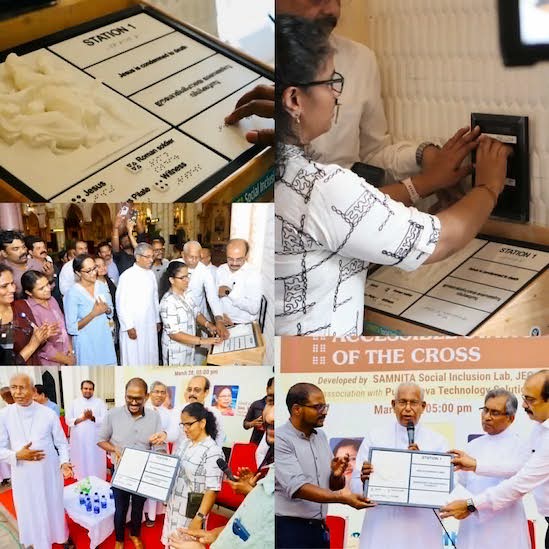
A church in India’s Kerala state has become the first site in the world to host a fully accessible “Stations of the Cross” for the blind.
In a historic milestone for inclusive design, Puthenpalli Church in Thrissur uses Artificial Intelligence (AI) and multi-sensory technology to allow visually impaired pilgrims to experience the spiritual journey independently.
For centuries, the 14 Stations of the Cross—which depict the final hours of Jesus Christ—have relied almost exclusively on visual art. For the millions living with visual impairments, this has often meant exclusion from a central part of their faith.
The new installation inaugurated this week changes this through a “high-tech, high-touch” approach:
-
3D Tactile Reliefs: Precision-engineered sculptures that the blind can “see” through touch.
-
AI-Optimised Textures: The team used AI to ensure textures are distinct enough for sensitive fingertips to interpret complex scenes.
-
Audio & Navigation: QR codes trigger immersive audio reflections in Malayalam and English, while Braille inscriptions and tactile floor paths guide users without the need for a sighted assistant.
The project was developed at the SAMNITA Social Inclusion Lab at Jyothi Engineering College, mentored by the startup Punarjeeva Technology Solutions.
Following the mantra “Nothing about us without us,” the student engineers collaborated directly with members of the visually impaired community. These consultants tested prototypes and provided feedback on the “readability” of the tactile surfaces, ensuring the final product was functional for daily prayer, not just a technical showcase.
The future of “empathy engineering”
Robin Tommy, the visionary behind the Samnita Lab, views the project as a blueprint for modern education. By aligning with the World Economic Forum’s 2030 future skills, the lab teaches students that human dignity is the ultimate goal of technology.
“Religious experiences should be a universal right,” said Fr. Jose Kannampuzha, Academic Director of Jyothi Engineering College. He praised the students for mastering “empathy engineering”—using their technical skills to solve fundamental human problems.
Some churches worldwide that offer accessible features for blind pilgrims:
Churches in Rome, Italy: Tactile maps and illustrative panels in Braille are being installed in several churches in Rome’s historical centre to enable access for blind people.
St. Sebastian’s Basilica Outside the Walls (Italy): This location offers Braille paths for blind visitors, particularly highlighted for the 2025 Jubilee.
Louis Braille’s House (Coupvray, France): While a museum/birthplace rather than a functional church, it is a significant pilgrimage site for the visually impaired and includes Braille materials, literature, and tactile exhibits.
Monastery of St. Anthony (Egypt): The St. Anthony Museum, associated with this ancient Coptic monastery, features Braille and tactile aids for visitors.
Additionally, the Xavier Society for the Blind provides religious and spiritual reading materials, including Sunday Mass propers, in Braille for pilgrims worldwide.
(Picture Courtesy: )